


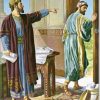
09/22 – Luke 16:1-15 – Did Jesus Really Say “Profit Through Sin”?
September 22, 2019
Grace, peace and mercy be to you in Jesus name. Amen.
There are many books that have been printed with titles like, “Hard Saying of the Bible” or “Difficult Teaching of Jesus.” There is one similarity in all of these book, this parable. This parable has been the source of much discussion and consternation by many people. It has also been used as a source for many false teachings. Preachers will take these words and twist them into something nearly unrecognizable as truly Christian.
When I approach a subject this challenging, and I want to ensure that what I am teaching you is accurate and true, I go to some of the preachers I respect. I look to men like Ken Klaus of the Lutheran Hour, Dr. David Schmidt a professor at the seminary, Dr. Paul E. Kretzmann a former seminary professor, and many others. I read what they have to say, measure and evaluate it through the tools given to me at the seminary and then bring it to you, prayerfully, in a way that makes sense to you, in a way that you understand.
As I began to study this text, and read through all of the notes and commentaries that I have at my disposal, I noticed something. Almost everybody skips this text. Almost everyone chooses not to write on these words. In fact of all those preachers that I occasionally look to, only one broached this subject. The one name I did not mention in my list above, Martin Luther. I did read many sermons on these words found in Luke, and all of them were terrible or worse.
You would be amazed at how these words have been twisted to mean things wholly contrary to God’s Word. Some tried to suggest that these verses prove we need to earn our way into Heaven. Some would teach that these words show God praises our works and deeds, and would then rewards us with salvation for them.
We must remember that faith is the source of our salvation, not works. Good works are the evidence of faith.1 Faith is not the result of works. Our godliness cannot be obtained without God’s grace. A person cannot be forced to be good. Rather a person whose heart is filled with grace will be good and a person whose heart is filled with hate will be seen for whom they are. It is faith that produces good works, not good works that produce faith.
Others have suggested that our salvation is based upon the opinions that others have of us. They would suggest that they can, or will, go to God’s throne and bear witness to our conduct and aid us in receiving our salvation. Here again they are doing little more than destroying God’s mercy. We are saved only by God’s grace. God our Father did not send His Son into the world because we were good people. The Father sent His Son while we were yet sinners,2 before we were made righteous in His sight, not after.
To suggest that we would stand before the throne of Almighty God with our good works as our witness is to eliminate Jesus and all He has done for us. He is the One who gave His life to save us. To replace Jesus with works is to ensure you have no salvation. God demands perfection.3 No one can achieve that goal.4 Jesus Christ is our mediator between the Father and mankind.5 This is why Jesus said, “No one comes to the Father except through Me.6”
So then what did Jesus mean when He said, “Make friends for yourselves with your wealth.7” Let the Bible interpret itself. Look to Matthew 25[:37-40]. There we read:
The people who have God’s approval will reply to him, ‘Lord, when did we see you hungry and feed you or see you thirsty and give you something to drink? When did we see you as a stranger and take you into our homes or see you in need of clothes and give you something to wear? When did we see you sick or in prison and visit you?’ “The king will answer them, ‘I can guarantee this truth: Whatever you did for one of my brothers or sisters, no matter how unimportant they seemed, you did for me.’
We make friends in this world by treating them the same way we want to be treated.8 We show our faith through our works. Those works do not earn our salvation they show our salvation. Because Jesus has already done so much, in fact done everything for us, we should, basking in that joy of His love, reflect that from our hearts to others.
These verses in Luke are misunderstood because people are reading the Bible as a list of clever quotes, little phrases of wisdom, and bumper sticker sayings. That is not what the Bible is. The Bible is for the most part a record of history. A record that shows us how God has saved us. This is why I often say “context counts.” We have to read the words in context. We don’t formulate our doctrine and confessions on a phrase here or a verse there. We read every verse in the context of all of Scripture. We let the Bible explain itself when things get difficult.
Too many would use these words as an excuse to make money. They would suggest that Jesus was teaching, “Make money anyway you can, even sinful profit is good as long as you are doing it for Jesus.” They may claim these words were written for them and their needs. They would be right, but not in the way they might think. These words are for them, but they are words that condemn them, not support them or condone their actions.
The first thing I want to do is explore the word ’wealth’ in verse nine. That word defines a special kind of wealth. It is extravagant wealth, wealth beyond what any person could need. Jesus calls this the “wealth of unrighteousness.” We are to understand this wealth is the kind that temps people to sin. It is what we heard in our Epistle9 reading when we heard, “The love of money is the root of evil.10” This is the kind of wealth Jesus is speaking about. That wealth that produces lies, deceit, greed and such evil things.
It is important to remember however, that it is not the wealth that is sinful or evil, but rather how that wealth is used or obtained. Wealth, like all blessings, is a gift from God. Just like good crops or a good job. They only become evil when we turn those gifts into something that tempts us to do evil with them, or when we begin to rely upon them more than we rely upon God; when we allow them to take God’s place.
Jesus’ parable shows a manager who is in charge of a wealthy man’s business. He has been squandering the wealth of his boss and managing it foolishly. Then he gets caught and is told he will be fired very soon. The wealthy man demands the accounting books so that he can see how badly the business has been managed. The manager knows what the books show. He knows he has no defense. So he uses the last little while in his position to ensure he will still live a comfortable life after he losses his job.
It does at first seem strange that the manager would be praised for doing something like that, but looking closer we see he wasn’t. The manager was not praised for his actions. In fact he was still fired. He was given credit for his cunning shrewdness. He used any and every means available to him to ensure he would be comfortable. The lesson Jesus wants to teach here is that we should be so wise and shrewd when it comes to our faith and what we do with it.
It was not the man’s unethical acts that were praised, but the clever way he kept himself out of harm’s way. This is an important contrast which we must maintain. Jesus does not contradict Himself. He doesn’t change His mind based on the situation. So where we see Him teaching something that doesn’t make sense, we have to re-evaluate our understanding.
The comparison of good things with evil things does not confuse the two. Evil does not become good and good does not become evil. A lie will never deliver the truth, and the truth is never a lie. They remain what they are, but they can both teach us useful things.
The lesson here for us is to be shrewd, cunning, determined and focused on salvation, our own and others’. We should be more eager to learn more about our God and the salvation He has given to us, than we are about gaining wealth. That is why Jesus says, “Worldly people are more clever than spiritually-minded people when it comes to dealing with others.11” He is saying that God’s children can learn something from worldly people. That being, stay focused in the prize.12
The lesson for us here is to understand that our first and primary goal, above all other things, should be the salvation God has given to us. We should focus on His Word, His promises, and His will for us. Then all that we do in life should reflect that focus and our desire to share that wonder with others. As we do our jobs, spend time with our families and friends, as we live out our lives, our Christian faith should shine like a beacon on a hill for all the world to see.13 Shining out to the nations saying, “I am saved by Jesus.” Because that is true wealth that cannot be destroyed.
That is the wealth Jesus would have us pursue with all that we can muster. Remember what Jesus taught:
Stop storing up treasures for yourselves on earth, where moths and rust destroy and thieves break in and steal. Instead, store up treasures for yourselves in heaven, where moths and rust don’t destroy and thieves don’t break in and steal. Your heart will be where your treasure is.14
The best treasure we have is our salvation. The best philanthropic work we can do is investing that wealth in others’ souls and working to bring God’s Word and God’s kingdom to all. That is work in which we should all be engaged.
In Jesus’ name.
Amen.
=======
NOTES
1James 2:18-22
2Romans 5:6-8
3Matthew 5:17-20
4Romans 3:21-25
51 Timothy 2:5-6
6John 14:6-7
7Luke 16:9
8Luke 6:30-31
9Epistle is a Greek word that means: “Letter”
101 Timothy 6:10
11Luke 16:8
122 Timothy 4:7-8
13Matthew 5:14-16
14Matthew 6:19-21


Leave a Reply